XIAMEN OLINK IMPORT & EXPORT CO., LTD
Especialmente desenvolve, produz e vende conectores / terminais / chicotes de fios / interruptores.


-
Ligue para nós 0592 6536915
-
Envia-nos um email sophia@fzolink.com
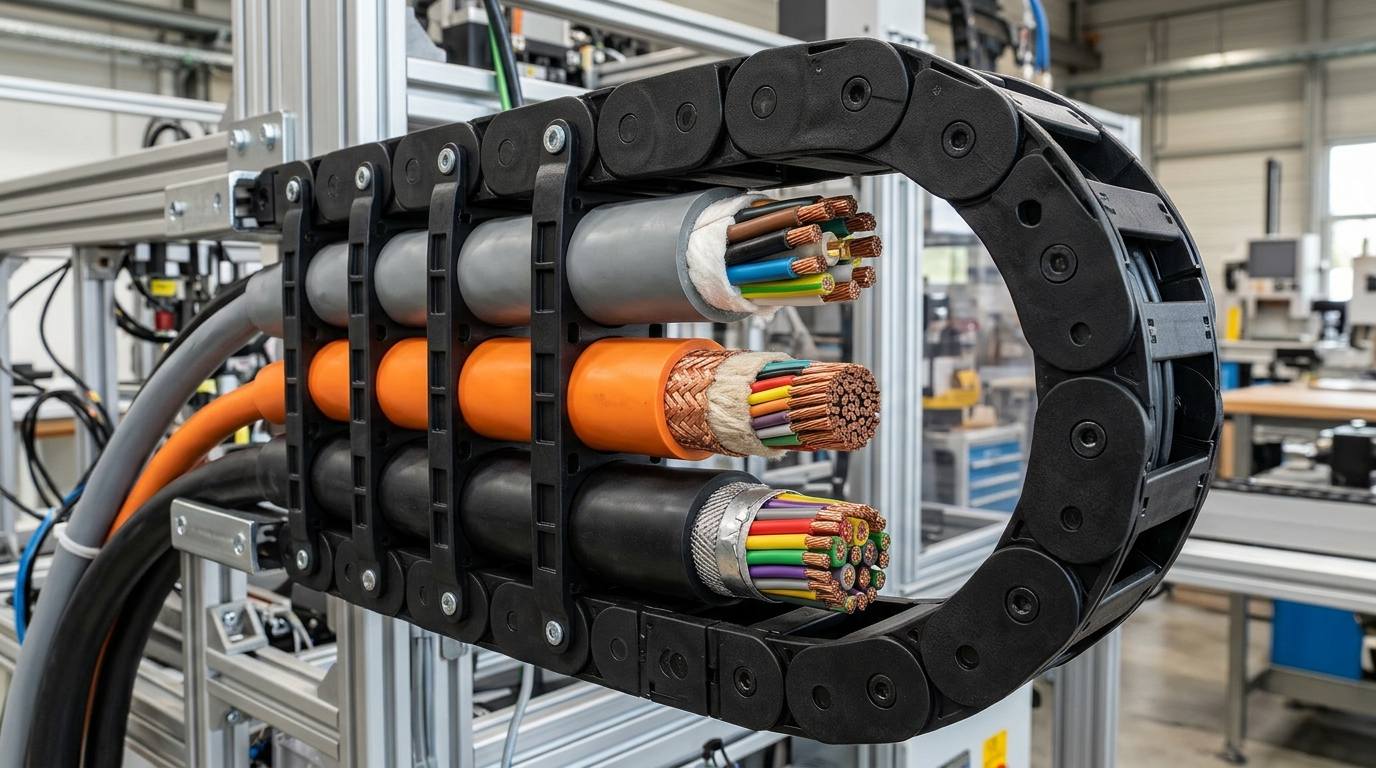
When designing an industrial wire harness, engineers naturally focus on conductor gauge (AWG), shielding density, and connector pinouts. Yet, in harsh factory floors and outdoor energy installations, the vast majority of premature cable failures begin on the outside. Once the outer cable jacket cracks, swells, or abrades through, cutting oils, coolants, and atmospheric moisture instantly infiltrate the assembly—triggering short circuits, signal corruption, and costly unplanned downtime.
Selecting the right jacketing polymer is a critical balance of mechanical flex life, chemical compatibility, thermal range, and total cost of ownership. The three dominant materials in modern industrial cabling are PVC (Polyvinyl Chloride), PUR (Polyurethane), and TPE (Thermoplastic Elastomer). This engineering guide breaks down the material science behind each compound to help you specify the exact insulation architecture your machinery requires.
PVC is the most widely used cable jacketing material in general electrical engineering. Naturally flame-retardant due to its high chlorine content, PVC easily meets stringent UL VW-1 and FT1 vertical flame tests without requiring expensive chemical additives. It is also exceptionally easy to extrude, strip, and terminate, making it the most economical choice for high-volume static wiring.
However, standard PVC relies on liquid plasticizers to remain flexible. When exposed to industrial cutting oils, hydraulic fluids, or high ambient heat (above 80°C), these plasticizers gradually leach out of the polymer matrix. As a result, the cable turns rock-hard, shrinks, and develops deep surface fractures. Furthermore, standard PVC becomes stiff below -5°C and cannot survive repetitive bending. Consequently, engineers should restrict PVC jackets to stationary control cabinets, indoor building automation, and fixed conduit runs free from dynamic motion or heavy chemical exposure.
When an industrial machine involves continuous motion—such as multi-axis robotic arms, automated gantry cranes, or CNC machining centers—standard PVC will fail within weeks. In these demanding environments, thermoplastic Polyurethane (PUR) is the undisputed engineering standard.
PUR is a remarkably tough, elastic polymer that exhibits extraordinary resistance to mechanical abrasion, sharp metal shavings, and tearing. Because it requires no migrating plasticizers, PUR is virtually impervious to mineral oils, synthetic coolants, and industrial lubricants. Even more importantly, PUR is inherently halogen-free. In the event of an electrical fire, halogen-free PUR does not emit toxic, corrosive hydrochloric acid gas that destroys sensitive PLC electronics and endangers personnel. For automated factory floors, specifying PUR-jacketed custom cable assemblies guarantees millions of continuous flex cycles in cable carriers while eliminating oil-induced jacket degradation.
Thermoplastic Elastomer (TPE) combines the elastic, rubber-like flexibility of thermoset elastomers with the clean processability of thermoplastics. Its standout engineering advantage is its exceptionally wide operating temperature window. While PVC stiffens near freezing and even standard PUR can lose suppleness in deep arctic conditions, specialized TPE compounds remain soft and flexible down to -50°C (-58°F) without cracking under mechanical impact.
In addition to sub-zero resilience, TPE offers superior resistance to ultraviolet (UV) sunlight, ozone, and prolonged moisture exposure. This makes TPE-jacketed harnesses an ideal partner for outdoor telemetry, cold-storage automation, and agricultural equipment. When terminating outdoor TPE cables, engineers pair them with IP68 plastic waterproof connectors to ensure the cable gland compresses evenly against the elastomer jacket. Similarly, in utility-scale renewable energy deployments where cables endure decades of desert sun and freezing nights, pairing weather-resistant cabling with UV-resistant solar PV connectors prevents premature insulation chalking and ground faults.
Beyond mechanical and chemical specs, global equipment exports require strict adherence to regional safety certifications such as UL 758 (AWM), CSA, and RoHS/REACH. Engineers must also consider how the cable jacket bonds to the connector during factory overmolding.
For an overmolded strain relief to achieve a true watertight IP68 seal, the overmolding resin must chemically fuse with the cable jacket. PVC jackets bond seamlessly with PVC overmolds, while PUR jackets bond best with PUR or specialized polyamide (PA) overmolds. Mismatching a slippery TPE jacket with an incompatible overmolding compound can leave a microscopic delamination gap where water enters the connector. Consulting with your cable assembly manufacturer during the prototyping phase ensures complete material compatibility from the copper core to the outer seal.
| Performance Metric | PVC (Polyvinyl Chloride) | PUR (Polyurethane) | TPE (Thermoplastic Elastomer) |
|---|---|---|---|
| Continuous Flex Life | Low (Static or occasional flexing only). | Excellent (5–10+ million drag chain cycles). | Very High (Superior torsional and cold flexing). |
| Oil & Chemical Resistance | Poor to Moderate (Plasticizers leach out). | Superior (Immune to cutting oils and coolants). | Good (Resists mild oils, acids, and alkalis). |
| Abrasion & Cut Resistance | Moderate (Prone to nicking and tearing). | Exceptional (Resists metal shavings and rough floors). | Good (Flexible, moderate tear strength). |
| Operating Temp Range | -10°C to +80°C (Standard grades). | -40°C to +90°C (Static/Dynamic). | -50°C to +105°C (Best for sub-zero cold). |
| Halogen-Free & Cost | Contains Halogens; Lowest BOM cost. | Halogen-Free (LSZH); Higher initial cost. | Halogen-Free; Moderate to High cost. |
Polyurethane (PUR) offers vastly superior mechanical tear resistance, abrasion endurance, and millions of continuous flex cycles without cracking. Standard PVC jackets stiffen, work-harden, and split rapidly under repetitive bending in automated cable carriers.
PUR (Polyurethane) provides the highest resistance to mineral oils, hydraulic fluids, coolants, and aggressive industrial solvents. Standard PVC absorbs plasticizer-leaching oils, causing the jacket to swell, turn brittle, and eventually fracture.
Thermoplastic Elastomer (TPE) is ideal for applications requiring extreme low-temperature flexibility down to -50°C, superior UV and ozone resistance for outdoor exposure, or cost-balanced high-flex performance where heavy oil immersion is less severe.
Choosing the right cable jacket is essential for preventing premature harness failure in harsh industrial environments. At Xiamen Olink, we engineer and manufacture custom PVC, PUR, and TPE wire harnesses paired with certified waterproof and industrial connectors, all backed by 100% automated continuity and Hi-Pot testing. Contact our engineering team today to match the ideal jacketing material to your machinery's exact environmental demands.
Tel : 0592 6536915
Móvel : 8613950494073
O email : sophia@fzolink.com
Skype : Zheng lris
Whatsapp : 8613950494073