XIAMEN OLINK IMPORT & EXPORT CO., LTD
Especialmente desenvolve, produz e vende conectores / terminais / chicotes de fios / interruptores.


-
Ligue para nós 0592 6536915
-
Envia-nos um email sophia@fzolink.com
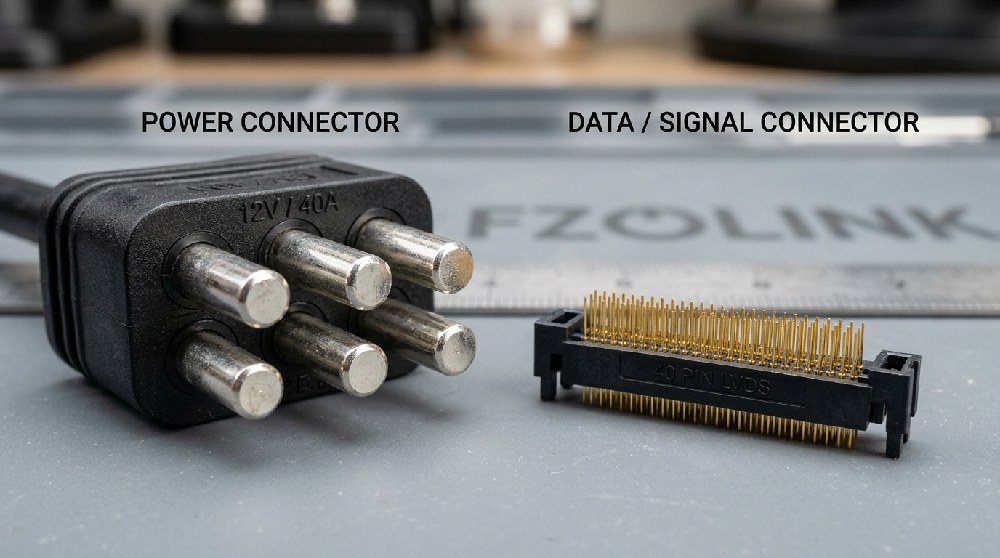
To understand the architecture of any modern industrial machine, one must look at how it manages electrical distribution. An automated robotic cell or a CNC machine functions much like the human body. It requires "muscle" to perform heavy physical labor, and it requires a "nervous system" to sense its environment, send commands, and communicate with the central brain (the PLC). In the realm of electrical engineering, these two distinct functions are handled by power connectors and signal connectors.
While they may look similar on the outside—often sharing the same rugged thermoplastic housings or circular metal shells—their internal engineering, metallurgy, and performance metrics are fundamentally different. Mixing them up or misunderstanding their distinct roles can lead to catastrophic hardware failure, thermal runaway, or corrupted data. This comprehensive technical guide breaks down the core differences between signal and power interconnects and explains how to specify the correct components for your industrial network.
The primary function of a power connector is to deliver high voltage and high continuous current (amperage) safely from a power supply to a load, such as an industrial servo motor or a battery energy storage system. Because they carry anywhere from 10A to over 300A, their greatest engineering enemy is Joule heating. Any resistance at the contact interface will generate massive amounts of heat, potentially melting the connector. Therefore, high-amperage industrial power connectors are designed with large surface areas and high contact normal force to keep electrical resistance as close to zero as physically possible.
Conversely, signal connectors carry very low voltages (often 5V, 12V, or 24V) and minuscule currents (measured in milliamperes). Their purpose is to transmit analog sensor readings, digital fieldbus protocols (like PROFINET or EtherCAT), or high-frequency video data. Heat generation is rarely an issue. Instead, their greatest enemy is signal degradation. A microscopic layer of oxidation or external electrical noise can corrupt the data packet, causing a robotic arm to miscalculate its position. Signal connectors prioritize pristine contact surfaces and electromagnetic isolation over raw current capacity.
The differences in operational objectives dictate entirely different material sciences at the contact pin level.
Power connectors utilize thick pins made from highly conductive copper alloys, heavily plated with Silver (Ag). Silver has the highest electrical and thermal conductivity of any metal. While silver does tarnish (oxidize) when exposed to air, silver oxide remains highly conductive. The high mechanical wiping force of a power connector during insertion easily pushes this tarnish aside, ensuring excellent power transmission.
Signal connectors, however, cannot rely on silver. The low voltage of a data signal is not strong enough to punch through even a thin layer of oxidation, and the low wiping force of delicate signal pins cannot scrape the tarnish away. Therefore, signal contacts are plated with Gold (Au). Gold is a noble metal that simply does not oxidize. Even after years of exposure to industrial humidity, a gold-plated pin guarantees a flawless, low-resistance path for high-speed digital data.
Factory floors are incredibly noisy environments from an electrical standpoint. High-voltage power cables, variable frequency drives (VFDs), and welding equipment emit strong electromagnetic fields. Power connectors are generally immune to this interference; a 400V power line is not going to be disrupted by ambient radio waves.
Signal connectors are highly vulnerable. If electromagnetic interference (EMI) or radio frequency interference (RFI) penetrates a data cable, it induces a stray voltage that the PLC might interpret as a false sensor reading. To prevent this, shielded metal circular signal connectors are strictly required. These connectors feature zinc or aluminum die-cast shells that form a 360-degree Faraday cage around the internal pins. When mated with a braided shield cable, they ensure that ambient electrical noise is grounded before it can reach the sensitive data lines.
Historically, engineers ran two separate cables to a device: one for power and one for data. However, the modern drive toward miniaturization in Industry 4.0 has led to the development of Hybrid Connectors. These advanced components combine high-current silver-plated power pins and gold-plated, shielded data pins within a single robust housing.
Designing a hybrid interface is highly complex, as the internal power pins must be heavily insulated to prevent their magnetic fields from interfering with the adjacent signal pins. By partnering with advanced manufacturers to produce mixed-signal custom cable assemblies, equipment builders can reduce the number of cables required for servo motors and robotics by 50%, drastically saving space, weight, and installation time.
| Attribute | Signal Connectors | Power Connectors |
|---|---|---|
| Primary Function | Transmit data, sensor readings, and digital fieldbus protocols. | Deliver high voltage/current to drive motors and equipment. |
| Voltage & Current | Low Voltage (5V - 48V), Low Current (mA to 2A). | High Voltage (120V - 1500V), High Current (10A - 300A+). |
| Contact Plating | Gold (Au): Prevents oxidation, ensures signal integrity. | Silver (Ag): Maximizes thermal and electrical conductivity. |
| EMI Shielding | Absolutely critical; requires 360-degree metal shielding. | Generally not required for standard power distribution. |
| Pin Density | High density; many tiny pins packed into a small area. | Low density; fewer, very thick pins for heat dissipation. |
The primary difference lies in their function: power connectors are designed to transmit high voltage and high current to drive machinery (focusing on heat dissipation and low resistance), while signal connectors transmit low-voltage data and sensor information (focusing on data integrity and EMI shielding).
It is highly discouraged. Power connectors typically use silver-plated contacts which can oxidize over time. While this doesn't affect high-current power, it can severely disrupt low-voltage, high-frequency digital signals which require the oxidation resistance of gold-plated contacts.
A hybrid connector combines both power contacts and shielded signal contacts within a single housing. This allows engineers to run power to a motor and receive data from its encoder using only one cable, saving significant space and installation time.
Choosing the right interconnect solution is the foundation of a reliable industrial network. At Xiamen Olink, we engineer and manufacture a complete portfolio of high-current power interfaces, precision gold-plated signal connectors, and advanced hybrid cable assemblies. Our ISO-certified manufacturing ensures your equipment operates flawlessly under the most extreme conditions. Contact our technical team today for expert guidance on your next connectivity project.
Tel : 0592 6536915
Móvel : 8613950494073
O email : sophia@fzolink.com
Skype : Zheng lris
Whatsapp : 8613950494073